Self-Supporting FTTH Flat Drop Cable: Types, Specification & Applications for Telecom Networks
As a pivotal component in modern telecom infrastructure, self-supporting FTTH flat drop cables deliver reliable, high-performance connectivity for diverse scenarios. Chinese manufacturers like Jera Line stand out in producing high-quality fiber optic cables, offering tailored solutions that meet global telecom standards. Below is a detailed overview of their types, specifications, and applications.
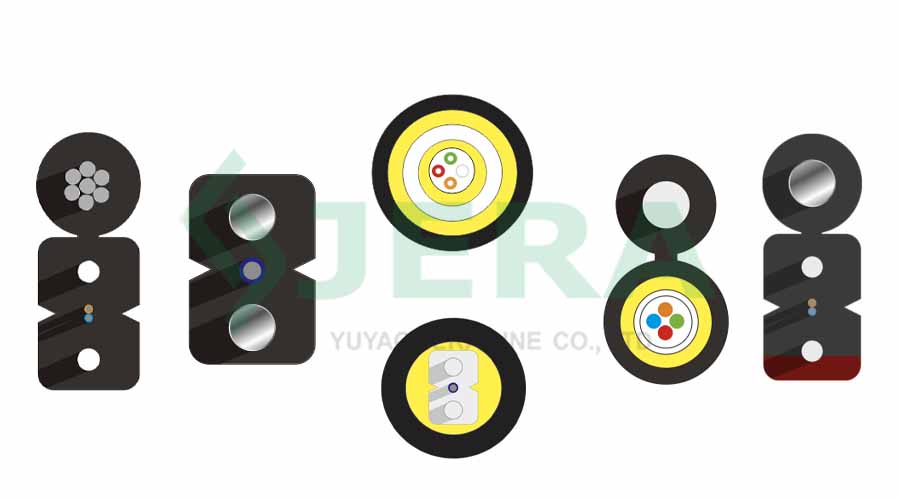
Types
Crafted entirely from dielectric materials (no metallic components), ADSS cables excel in strong electromagnetic field environments such as high-voltage power line zones. Widely adopted in power communication systems, they leverage existing power infrastructure to link facilities, ensuring interference-free, stable data transmission for monitoring and control. Their self-supporting design enables hassle-free long-span installation across challenging terrains like rivers or valleys.
-
Optical Power Composite Cable (OPCC):
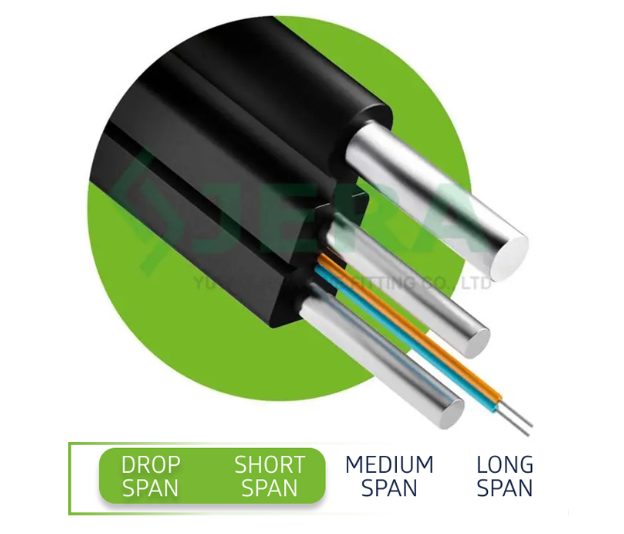
Integrating power transmission and fiber-optic communication via optical cores and electrical conductors, OPCC is ideal for scenarios requiring simultaneous power and connectivity—such as 5G base stations (supporting equipment operation and high-speed data traffic) and smart buildings (powering intelligent devices and enabling network access). It simplifies installation, cuts infrastructure costs, and eases maintenance.
Specifications
-
Fiber Core Parameters: Core configuration (single-core or multi-core) and type determine performance. Single-core cables suit basic residential FTTH point-to-point connections, while multi-core variants (4-core, 6-core, 12-core, etc.) cater to small businesses needing multiple data streams or redundancy. Common fiber types include low-attenuation G.652 (for long-haul/city-wide networks) and bend-insensitive G.657 (A1/A2) for in-building/last-mile deployments.
-
Mechanical Properties: Tensile strength ensures resistance to pulling forces from weight, wind, maintenance, or extreme weather during overhead installation, preventing breakage. Adhering to minimum bending radius requirements is critical—exceeding it causes signal loss or fiber damage, so smooth bends are essential.
-
Sheath Materials: LSZH (low-smoke-zero-halogen) sheaths are fire-safe for indoor use (residences, offices), while polyethylene sheaths offer moisture/UV resistance for outdoor overhead/buried applications.
Applications
-
Residential FTTH: Solving the "last-mile" challenge, these cables connect fiber distribution boxes to households. Easy to install via brackets (no complex supports), they enable 4K/8K streaming, gaming, and remote work without major construction.
-
Business/Enterprise Networks: Supporting high-speed, stable connectivity in corporate parks, they link offices and data centers, facilitating office automation, large data transfers, and cloud services—boosting operational efficiency.
-
Outdoor/Long-Distance Connectivity: Ideal for rural broadband or remote stations, they suspend directly between poles (no extra steel supports), reducing costs. Durable against harsh weather, they offer cost-effective solutions where underground cabling is unfeasible.
Conclusion
With diverse types (ADSS for EMI-prone areas, OPCC for integrated power/communication) and tailored specs, self-supporting FTTH flat drop cables—produced by leading Chinese manufacturers like Jera Line—are versatile for residential, enterprise, and outdoor use. As 5G and IoT evolve, ongoing innovation will keep these cables at the forefront of modern telecom infrastructure.




.png)