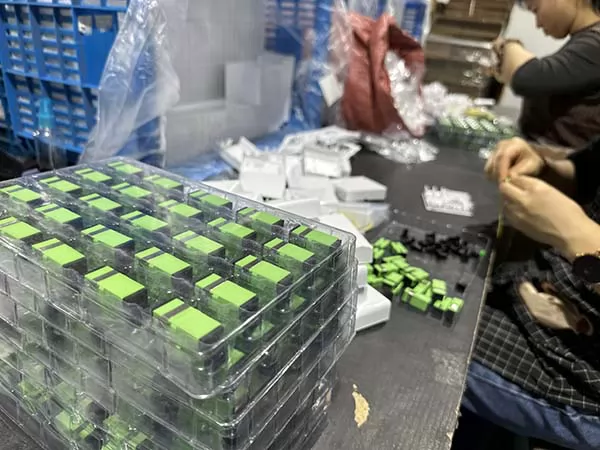
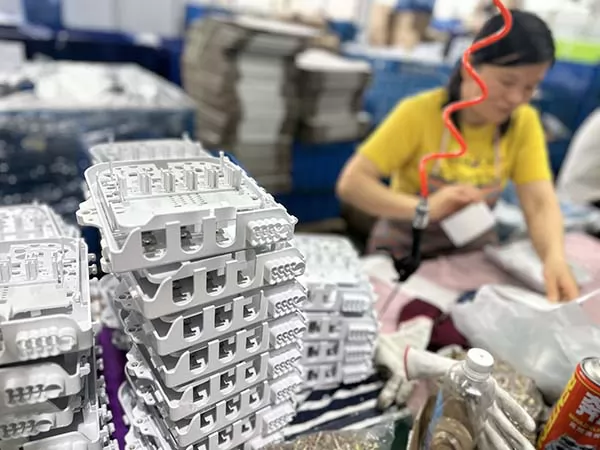
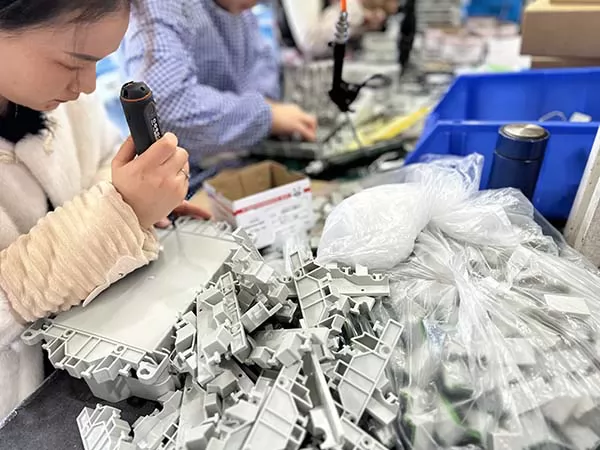
Jera Fiber has built a standardized, specialized assembly workshop equipped with three independent dedicated assembly stations, laying a solid hardware foundation for the mass production of various optical communication hardware accessories. Different from simple single-component finished goods, most assembly products manufactured in our workshop are composed of four or more individual spare parts, including injection-molded housings, metal stamping components, plastic fasteners, rubber sealing parts, fixing accessories and other auxiliary fittings. Each finished hardware accessory must go through complete sequential assembly procedures on professional production lines to complete component matching, positioning fastening, structural combination and quality inspection one by one. After all assembly procedures are fully completed and passed internal spot checking, qualified finished products will enter the unified packaging process for sorting, bagging, boxing, labeling and finished product warehousing. To break the bottleneck of traditional manual back-and-forth material transportation and low handover efficiency between working stations, our factory introduces mature conveyor system technology to run through the whole assembly workflow. This streamlined logistics transmission mode effectively connects each working procedure seamlessly, greatly shortening material circulation time between processes, raising overall assembly throughput and stabilizing continuous production rhythm day by day.
The product portfolio undertaken by Jera’s assembly workshop is highly targeted to FTTH fiber access engineering, overhead optical cable erection, line fixing protection and auxiliary wiring construction needs for both telecommunication and power transmission networks, covering three major core product series with complete matching specifications and rich model selections. The first category covers FTTH terminal boxes and FTTH splice closures, which are essential junction and protection units for fiber splicing, branching, routing transition and fiber end termination in fiber-to-the-home projects. These enclosures are assembled with internal fiber trays, fixing brackets, sealing gaskets, cable entry fittings, locking buckles and waterproof accessories, requiring precise assembly to guarantee waterproof, dustproof and anti-corrosion performance for long-term outdoor and wall-mounted use. The second product line focuses on FTTH cable anchoring clamps and suspension clamps, core tension-bearing hardware used for fixing self-supporting drop cables during overhead aerial laying. Assembly work includes matching metal tension components, plastic clamping seats, fastening screws, anti-slip rubber liners and positioning fittings, ensuring stable tensile performance to prevent cable sagging, sliding or damage under long-term wind and external force. The third series is drop wire clamps specially designed for fixing and routing drop cables on utility poles, building exterior walls and bracket surfaces. Assembly involves combining clamping bodies, locking structures, anti-abrasion cushions and installation fasteners, with strict assembly consistency to guarantee clamping firmness while avoiding extrusion damage to optical cable outer jackets. All three product lines support both standardized mass production and customized structural assembly according to customer drawings and project requirements.
In order to standardize operation standards, reduce assembly error rates, unify product consistency and continuously optimize line balance efficiency, Jera has formulated a complete seven-step standardized construction and operation system for high-efficiency assembly line operation, forming a closed-loop management mechanism from planning design to formal implementation. Step one is overall sorting and rational planning of workshop technological processes, sorting out the sequence of component feeding, pre-assembly, main assembly, intermediate inspection, finishing assembly, testing and packaging according to structural characteristics of each product, eliminating redundant cross-operation and unreasonable process reversal. Step two is implementing clear segmentation and division of assembly work content, assigning exclusive operation content to each station, defining clear job responsibilities, operation standards and production quotas for each post to avoid repeated work and ambiguous handover. Step three is on-site post layout planning and fixed-position posting, marking material placement areas, semi-finished product turnover areas, tool storage positions and finished product temporary storage areas with standardized identification signs, realizing fixed-point placement of all materials and tools for quick access. Step four is formal trial running of assembly work in strict accordance with formulated process routes and station division, arranging skilled frontline operators for small-batch trial assembly, recording actual production bottlenecks, operation difficulties and unstable assembly links on site. Step five is organizing regular team seminars to summarize on-site trial operation problems, collectively discussing feasible optimization schemes for process bottlenecks, time-consuming operations and assembly defect causes, collecting practical improvement suggestions from frontline operators and technical supervisors. Step six is targeted optimization design oriented to actual production conditions, adjusting station layout, optimizing tooling fixtures, modifying material feeding modes or simplifying complicated assembly actions according to summarized improvement plans to match actual workshop production demands. Step seven is full-scale formal implementation of optimized assembly flow, promoting standardized operation across the whole production line, implementing regular patrol inspection and dynamic adjustment to maintain long-term efficient and stable operation of the assembly system.
The conveyor system deployed throughout Jera’s assembly workshop serves as the core carrier to implement our optimized seven-step assembly management system and realize lean production upgrading. In traditional manual assembly modes, operators need to repeatedly carry semi-finished products between adjacent stations, wasting a great deal of time on material handling, easily causing stacking confusion of semi-finished goods, and leading to unbalanced production pace between front and back processes. Our running conveyor belt continuously transports raw spare parts, semi-finished assemblies and finished products automatically between each assembly station, realizing uninterrupted material circulation from raw material feeding to final finished packaging. This intelligent logistics configuration brings multiple tangible advantages to factory operation management. First, overall assembly production efficiency is significantly improved; waiting time caused by manual material transportation is eliminated, single-line daily output can be steadily lifted, and production delivery capacity for bulk orders is strengthened. Second, comprehensive manufacturing costs are effectively controlled; reduced invalid handling loss lowers internal logistics consumption, while unified flowing production reduces product bump damage and defective rate generated in turnover processes, cutting rework and waste costs. Third, the conveyor layout reasonably optimizes labor allocation, reduces repetitive physical handling work for operators, lowers dependence on excessive material-handling staff, optimizes overall staffing structure, and helps our workshop move forward toward semi-automated and moderately automated assembly production mode step by step. Fourth, standardized flowing production is more convenient for production supervisors to track real-time progress of each order, monitor product qualification rate at each station, and conduct real-time quality intervention for abnormal assembly links, which is beneficial for long-term stable quality control of assembled hardware products.
Guided by the overall development orientation of matching optical communication and power distribution infrastructure construction worldwide, Jera Fiber positions our assembly workshop as an important supporting production segment to realize one-stop supply of optical cable, optical accessories and line hardware. Our core development goal is to design, manufacture and supply a full range of structurally stable, reliably performing, cost-competitive assembly hardware products for global telecommunication network operators, engineering contractors, power system construction companies, system integrators and trading distributors. Whether customers need conventional standard bulk procurement of FTTH boxes, cable clamps and splicing closures, or personalized customized assembly schemes with special sizes, structural improvements and special surface treatment requirements, our technical and production team can provide targeted solutions and stable delivery support. Adhering to the business principle of integrity-based quality management and win-win long-term cooperation, we sincerely welcome global customers to initiate communication regarding product samples, factory inspections, bulk order quotations and customized development demands. We are committed to establishing stable, mutually beneficial and long-term strategic cooperative partnerships with partners from all over the world, jointly supporting high-quality construction and upgrading of global communication and power distribution network infrastructure.




.png)