As fiber optic networks continue to expand across residential, commercial, industrial, and telecommunications applications, outdoor fiber distribution equipment has become an increasingly important part of modern FTTH and GPON infrastructure. Among the various products used in fiber access networks, a Caja Terminal Acceso Óptico, or outdoor optical fiber access terminal box, plays an important role in organizing, protecting, splicing, and distributing optical fibers.
Choosing the right optical access terminal box is not simply a matter of selecting a box with the correct number of ports. Network operators, installers, contractors, and distributors need to consider several factors, including fiber capacity, splitter configuration, cable compatibility, environmental resistance, fiber management, installation convenience, maintenance requirements, and future network expansion.
For outdoor applications, these considerations become even more important because the equipment may be exposed to sunlight, temperature changes, humidity, and other environmental conditions throughout its service life.

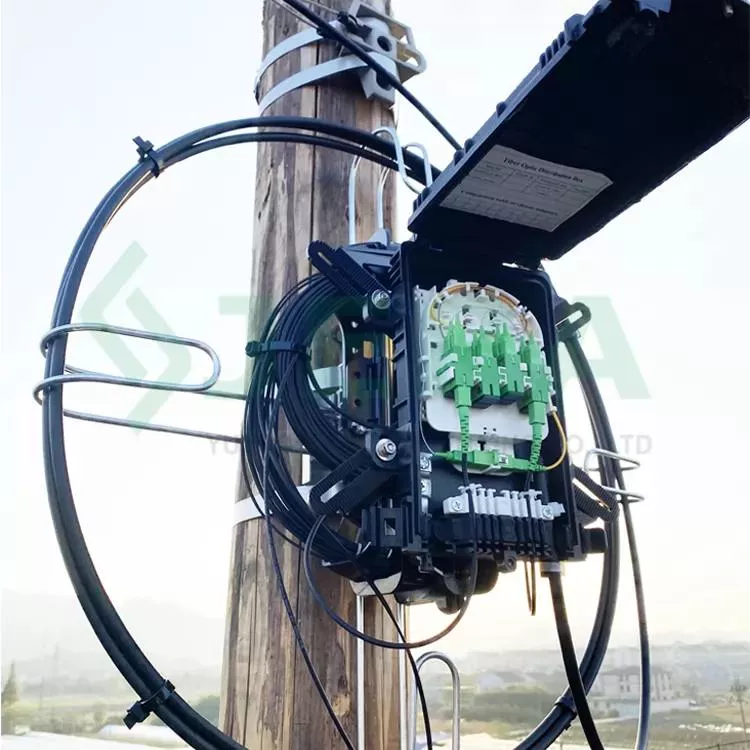
In this guide, we explain the key factors to consider when selecting a Caja Terminal Acceso Óptico for outdoor fiber networks, and introduce the Jera Line FODB-8.6 GPON Outdoor Fiber Optic Distribution Box as an example of a compact and practical solution for FTTH and GPON deployments.
What Is a Caja Terminal Acceso Óptico?
The term Caja Terminal Acceso Óptico is commonly used in Spanish-speaking markets to describe an optical access terminal box or fiber optic terminal/distribution box.
In an FTTH network, optical fibers need to be connected, organized, spliced, split, and distributed at different points between the main network and end users. An optical terminal box provides a protected location where these functions can be managed.
Depending on the network design, an optical access terminal box may provide space for:
A suitable terminal box therefore acts as more than a simple protective enclosure. It becomes an important connection point within the fiber access network.
For GPON and FTTH applications, the box may also incorporate a PLC splitter. The splitter allows one optical input signal to be distributed to multiple downstream fiber connections, helping network operators serve several subscribers from a single distribution point.
The Jera Line FODB-8.6, for example, is designed with an internal optical splitter module and an optical fiber connection module. The splitter distributes optical signals to multiple output ports, while the fiber connection module provides a location for connecting optical fiber cables.
Why Is Choosing the Right Optical Terminal Box Important?
The terminal box is often installed at a point where multiple fibers come together. If the box is too small, difficult to install, poorly organized, or unsuitable for outdoor conditions, it can create problems for installation and future maintenance.
A properly selected Caja Terminal Acceso Óptico should provide an appropriate balance between capacity, protection, accessibility, installation efficiency, and network requirements.
For example, selecting a box with excessive capacity may increase equipment cost and installation space without providing practical benefits. On the other hand, selecting a box with insufficient capacity can make fiber routing difficult and leave little room for future connections.
The right product should therefore match the actual network architecture rather than simply being selected based on appearance or price.
1. Determine the Required Fiber Capacity
The first factor to consider is fiber capacity.
Before selecting an optical terminal box, determine how many fibers and subscriber drop cables need to be connected at the distribution point.
A small FTTH deployment may only require several drop cable connections, while a larger distribution point may need significantly more ports and splice capacity.
When evaluating a box, check:
-
Number of input cables
-
Number of output/drop cables
-
Number of adapters
-
Maximum splice capacity
-
Available internal space
-
Required splitter capacity
The FODB-8.6, for example, is designed with 8 drop cable connections and 8 SC adapters. It supports a maximum splicing capacity of 16 fibers, or up to 32 fibers with a two-layer configuration.
This makes it particularly suitable for compact FTTH and GPON distribution points where a large fiber distribution cabinet is not necessary.
Why Capacity Matters
Fiber capacity should not be considered only from the perspective of today's installation.
If the network is expected to grow, it may be useful to select a terminal box with some additional capacity. This can provide space for future subscriber connections without requiring a complete replacement of the distribution equipment.
However, unnecessary oversizing should also be avoided. A compact box can be more convenient when the application only requires a limited number of connections.
The ideal capacity depends on the actual network architecture and planned expansion.
2. Check the PLC Splitter Configuration
For GPON networks, another important consideration is the optical splitter configuration.
A PLC splitter divides one optical signal into multiple outputs. This allows a single feeder fiber to serve multiple downstream users.
When choosing a Caja Terminal Acceso Óptico for a GPON project, check whether the box can accommodate the required splitter configuration.
The FODB-8.6 supports:
-
2 × 1:4 PLC splitters
-
1 × 1:8 PLC splitter
This flexibility allows the same box design to be used for different small-scale GPON distribution requirements.
The correct splitter configuration should be selected according to the optical network design, required number of subscribers, optical budget, and distribution architecture.
It is important to remember that the terminal box itself does not determine the complete GPON optical budget. The splitter ratio, fiber length, connector losses, splice losses, and other network components must all be considered during system design.
3. Consider Cable Entry and Drop Cable Compatibility
A terminal box is only useful if the cables can be properly installed and managed.
Before purchasing an outdoor optical terminal box, check the cable entry dimensions and the supported drop cable sizes.
The FODB-8.6 supports input cable diameters of 2 × Ø5--14 mm and output drop cable configurations of 8 × 2.0 × 3.0 mm or 8 × Ø3.0--2.0 mm.
Cable compatibility is important because different FTTH networks may use different types of drop cables.
If the cable entry is too small, installers may not be able to install the required cable properly. If it is excessively large, cable fixation and sealing may become more difficult.
Therefore, the cable diameter range should always be compared with the actual cable specification used in the project.
4. Evaluate the Fiber Splicing Space
Fiber splicing requires sufficient working space.
A box that has enough external ports but insufficient internal space can still be difficult to install and maintain.
When selecting an optical access terminal box, pay attention to the design of the splice tray and internal fiber routing area.
The FODB-8.6 features an extended splice tray designed to accommodate 1:4 or 1:8 splitters while also providing additional space for cable splicing.
The splice tray can also be removed from the mounted box when required. This provides installers with greater flexibility when performing assembly, splicing, or maintenance.
A practical splice tray should make it possible to:
-
Route incoming fibers properly.
-
Organize fiber slack.
-
Complete splicing in an organized area.
-
Install the required splitter.
-
Access the fibers for future maintenance.
Good internal organization is particularly important because fiber optic cables and fibers should be handled carefully during installation.
5. Look for Convenient Installation and Maintenance
An outdoor terminal box should not only be easy to install the first time. It should also be convenient to maintain later.
FTTH networks are often expanded gradually. New subscribers may be connected after the initial installation, and existing connections may need to be inspected or serviced.
For this reason, installers should consider whether the internal components are easy to access.
The FODB-8.6 is designed with a removable splice tray, which can be taken apart from the mounted box when necessary. This provides greater flexibility during installation and maintenance.
The design also provides safe internal access for future end-user connections.
This is particularly useful in subscriber access networks where the distribution box may need to be opened several times during the network lifecycle.
6. Consider Protection for Internal Optical Components
A fiber terminal box should protect sensitive optical components from unnecessary mechanical impact.
The FODB-8.6 includes a lid designed to secure the PLC splitter and adapters inside the enclosure.
This protective structure helps reduce the possibility of accidental impact to internal components during installation and operation.
When comparing different optical terminal boxes, consider how the internal components are secured and whether the box provides enough space to keep fibers and components properly organized.
A well-organized interior can reduce unnecessary bending, interference, and accidental damage during maintenance.
7. Outdoor Environmental Resistance Is Essential
One of the biggest differences between indoor and outdoor fiber distribution equipment is the operating environment.
Outdoor equipment can experience:
-
Direct sunlight
-
UV radiation
-
High temperatures
-
Low temperatures
-
Humidity
-
Temperature fluctuations
-
Rain and other weather conditions
Therefore, an outdoor Caja Terminal Acceso Óptico should be designed for the environmental conditions where it will be installed.
The FODB-8.6 features an outdoor UV-resistant design and is intended for FTTH GPON applications.
8. Ask About UV and Temperature Aging Tests
UV and temperature aging tests can help evaluate how materials and products perform under simulated environmental conditions.
Jera Line conducts UV and temperature aging tests on a range of overhead cable products and accessories, including fiber optic splice closures, fiber optic distribution boxes, fiber optic cables, anchor clamps, and FTTH drop cable clamps.
During the climatic aging test, products are placed into a controlled test chamber with preset conditions for temperature, humidity, and UV radiation.
The products undergo multiple cycles of changing environmental conditions. Test parameters such as radiation, temperature, humidity, and test time are controlled using equipment including radiometers and thermometers.
This type of testing is important when selecting equipment for outdoor networks because the terminal box may remain installed outdoors for many years.
When evaluating a supplier, therefore, it is useful to ask not only for product specifications but also about the manufacturer's testing and quality control capabilities.
However, environmental resistance should not be evaluated only by looking at the material specification. A reliable manufacturer should also conduct appropriate environmental testing during product development and quality control.
9. Check the Overall Dimensions
The physical dimensions of the terminal box should match the available installation space.
A compact box is particularly useful when the distribution point needs to be installed on a pole, wall, or other location where space is limited.
The FODB-8.6 measures:
230 × 158 × 50 mm
Despite its compact dimensions, it provides space for 8 SC adapters, fiber splicing, and the supported PLC splitter configurations.
When comparing products, do not look only at the external dimensions. It is also important to compare the usable internal space and the actual fiber capacity.
Two boxes with similar external dimensions may have very different internal layouts and installation efficiency.
10. Consider Future Network Expansion
An outdoor fiber distribution box can remain part of the network for a long time. Therefore, future expansion should be considered during product selection.
For example, a network may initially serve only four subscribers but later need to support eight.
A terminal box supporting multiple splitter configurations and sufficient adapter capacity can provide greater flexibility.
The FODB-8.6 supports either 2 × 1:4 splitters or 1 × 1:8 splitter configurations, while also providing 8 SC adapter ports.
This gives network planners flexibility when designing compact GPON distribution points.
However, future expansion should always be evaluated according to the actual project requirements. The objective is to select an appropriate amount of capacity without making the equipment unnecessarily large or expensive.
11. Consider Fiber Management
Fiber management is one of the most important aspects of an optical terminal box.
A good design should provide clear separation and organization between incoming cables, spliced fibers, splitter connections, and outgoing drop cables.
Poor fiber management can make installation more difficult and increase the time required for troubleshooting or maintenance.
The extended splice tray of the FODB-8.6 provides additional space for cable splicing and splitter installation. Its removable structure also provides easier access to the internal components.
When evaluating a product, look at the actual internal layout rather than judging the product only by its external appearance.
A well-designed box should help installers keep fibers organized throughout the installation process.
12. Compare the Total Value, Not Only the Unit Price
When purchasing optical terminal boxes in large quantities, price is naturally an important factor.
However, the lowest unit price does not necessarily mean the lowest overall project cost.
A more practical evaluation should include:
-
Product quality
-
Installation time
-
Fiber management efficiency
-
Maintenance convenience
-
Environmental performance
-
Product capacity
-
Compatibility with existing cables
-
Splitter configuration
-
Supplier production capability
-
Quality control
-
Delivery reliability
A box that costs slightly more but significantly reduces installation and maintenance time may provide better overall value.
For telecom contractors and distributors, consistent product quality is also important because repeated projects require predictable performance.




.png)