As global demand for high‑speed broadband surges, FTTX networks have become the foundation of modern digital connectivity. Whether deploying FTTH, FTTB, or FTTC, engineers and operators face consistent challenges: balancing density, performance, reliability, installation speed, and total cost. Among the many cabling options, the 12 fiber SC/APC Fanout cable 55 meters stands out as a practical, future‑ready, and cost‑effective solution for mainstream FTTX rollouts. This article explains why it has become a preferred choice for access networks, distribution frames, splitters, and ONU connections worldwide.
Jera line is a direct factory who mainly produce fiber optic cable and related accessories for indoor and outdoor FTTx deployments. All jera cable were verified in factory’s laboratory or 3rd party laboratory, inspection or test including insertion losses and return losses test, tensile strength test, temperature and Humidity Cycling Test, UV aging test and etc which are according to the standards of IEC-60794, RoHS and CE.
Jera offers all relevant passive optic network distribution accessories such as: fiber optic drop cable, ftth fiber optic terminal boxes, drop wire clamps, fiber optic splice closure, and etc.
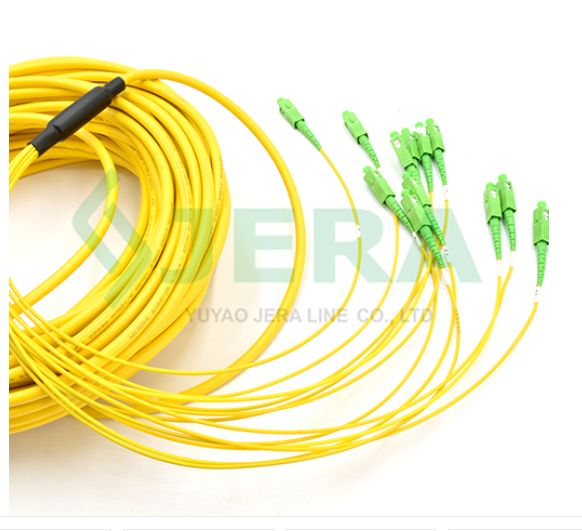
What Is a 12-Fiber SC/APC Fanout Cable?
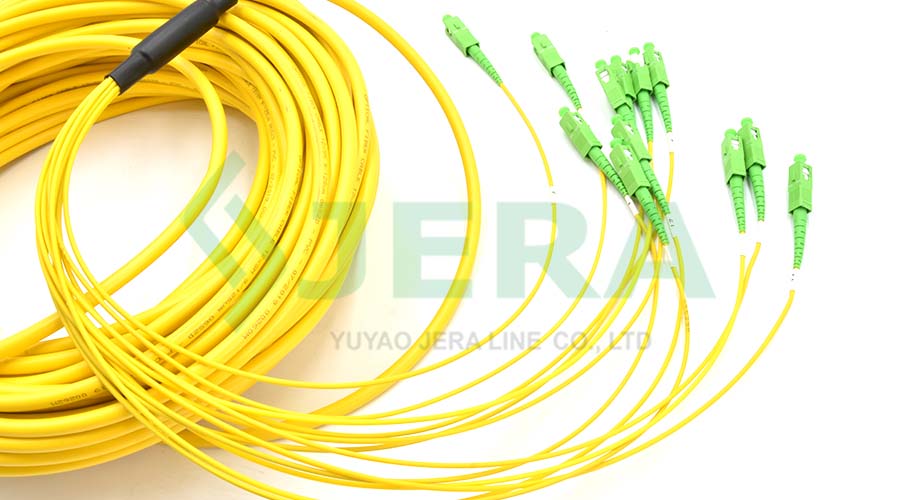
First, let’s clarify the terminology. A fanout cable (also called a breakout or harness cable) is a pre-assembled assembly that splits a multi-fiber backbone into individual connectorized fibers. A 12-fiber SC/APC fanout takes a 12-strand singlemode cable and separates it into 12 simplex legs, each terminated with a SC/APC connector — the square push‑pull connector with an 8° angled ferrule for ultra-low back reflection. At 55 meters, this cable strikes a balance between reach and manageability, making it highly versatile in real-world distribution networks.
1. SC/APC Connectors Deliver Superior Optical Performance for FTTX
The single most important reason to choose SC/APC over UPC or PC in FTTX is signal purity.
-
SC/APC provides return loss ≥60 dB, drastically reducing reflected light that degrades video, RF, and high-speed data signals.
-
Low insertion loss (typically ≤0.2 dB per connector) ensures consistent power budget across splitters, nodes, and customer premises.
-
The 8° angled polish prevents interference in PON (Passive Optical Network) architectures, where optical splitters are widely used.
For FTTX networks carrying internet, IPTV, VoIP, and 5G backhaul, this stability is non‑negotiable. SC/APC is the de facto standard for carrier-grade FTTX, and the 12-fiber fanout format multiplies this benefit across multiple subscriber lines.
2. 12-Fiber Count: Ideal Density for Residential & MDU Deployments
Why 12 fibers, not 8, 24, or 48? Because 12 is the most efficient density for typical FTTX scenarios:
-
A single 12-fiber fanout serves up to 12 residential units or multiple ports in a multi-dwelling unit (MDU).
-
It aligns perfectly with standard 12-port ODFs, patch panels, and splice trays, eliminating wasted ports or overcrowded racks.
-
12-fiber configurations simplify cable management, color coding (per TIA/EIA�598), and troubleshooting.
-
For network planners, 12 fibers offer room for growth: main data, backup, IPTV, and future 10G/40G upgrades without immediate overinvestment.In short, 12 fibers match the real-world scale of neighborhood FTTX deployment — not too small, not excessively large.
3. 55-Meter Length: The Practical Sweet Spot for FTTX Routing
Length selection directly impacts installation speed and cost. A 55m fanout cable is engineered for real-world duct, conduit, and vertical routing:
-
It easily bridges the distance between street cabinets, building distribution boxes, and floor‑to‑floor risers.
-
Longer cables (e.g., 100m) add unnecessary bulk, weight, and cost; shorter cables limit routing flexibility.
-
55m supports both underground conduit runs and overhead drops common in suburban and urban FTTX.
-
Pre‑terminated 55m assemblies reduce on‑site splicing, which saves labor, lowers failure points, and speeds up project timelines.
This length is repeatedly proven in field deployments as the most versatile for mid‑distance FTTX connections.
4. Bend‑Insensitive & Rugged Design for Harsh Installation Environments
High‑quality 12-fiber SC/APC fanout cables use G.657A1/A2 bend‑insensitive singlemode fiber, a must for FTTX:
-
Tolerates tight bends in narrow conduits, wall corners, and riser pathways without signal loss.
-
LSZH (Low Smoke Zero Halogen) jacket ensures safety in indoor and building spaces.
-
Durable 2.0mm or 3.0mm sub-cables withstand pulling, crushing, and outdoor UV exposure.
-
Ceramic ferrules and reinforced connectors maintain performance through hundreds of matings.
FTTX installations often involve challenging environments — tight spaces, rough handling, and varying temperatures. This cable design survives and performs.
5. Pre-Terminated Fanout = Faster Deployment & Lower Labor Cost
Labor is the largest expense in FTTX rollouts. Pre‑terminated fanout cables transform installation:
-
Plug‑and‑play: No field termination, no polishing, no fusion splicing on location.
-
Technicians simply route, connect, and test — cutting deployment time by up to 50%.
-
Factory‑built and 100% optically tested, ensuring consistent, compliant performance (Telcordia GR‑326, IEC, TIA).
-
Reduces human error and rework, lowering operational costs and improving project profitability.
For contractors and ISPs scaling FTTX across hundreds or thousands of homes, this efficiency directly impacts the bottom line.
6. Future-Proofing for Upcoming Bandwidth Demands
FTTX networks are long‑term investments. The 12-fiber SC/APC fanout (55m) supports tomorrow’s needs:
-
Fully compatible with XGS‑PON, 10G PON, and next‑gen high‑speed access technologies.
-
Supports WDM (Wavelength Division Multiplexing) for expanded capacity without new cabling.
-
Modular design allows simple upgrades and reconfiguration as subscriber demand grows.
Rather than installing minimal fiber and facing costly retrofits later, operators choose 12‑fiber assemblies to build in headroom.
Applications
This cable excels across key FTTX use cases:
-
FTTH connections from optical distribution frames to subscriber splitters
-
MDU and apartment building vertical riser links
-
PON splitter cabinet patching and multi‑port connections
-
Campus and commercial FTTB backbone breakout
-
5G mobile site fiber access and transport links
-
Across these scenarios, it delivers consistent performance and ease of use.
Conclusion
The 12-fiber SC/APC fanout cable in 55-meter length is far more than a commodity component — it is a purpose-built solution that aligns with every critical goal of modern FTTX deployment: superior signal quality, optimal fiber density, practical routing length, rugged durability, fast installation, and future readiness.
For network operators, contractors, and engineers building reliable, scalable, and cost‑effective fiber networks, this configuration is not just a choice — it is a standard that reduces risk, speeds up time‑to‑service, and improves long‑term network satisfaction. When planning your next FTTX project, specifying a 12-fiber SC/APC fanout (55m) is a decision that balances performance, practicality, and profitability.
In fiber‑optic broadband, every connection matters. Choose the fanout cable that turns FTTX complexity into simplicity.




.png)