In the intricate world of fiber optic network infrastructure, selecting the right passive components is just as critical as choosing the active gear. At the heart of many modern installations, especially in Fiber-to-the-Home (FTTH) and multi-dwelling unit (MDU) projects, lies a seemingly simple yet profoundly important device: the fiber box. Today, we’re putting a spotlight on a specific powerhouse—the FODB-8E.3-2B—and exploring why its 16-core capacity makes it an exceptional choice for robust and future-proof networks.
Often called a fiber optic terminal box, distribution box, or closure, a fiber box is the unsung hero of optical networks. It serves as a critical junction point, a protective housing, and a management hub for fiber optic cables. Its primary functions are:
-
Splicing & Termination: It provides a secure, organized environment for splicing the incoming feeder cable (from the main network) to the outgoing drop cables (leading to individual customers or endpoints).
-
Distribution & Splitting: It houses passive optical splitters that divide the signal from a single fiber to multiple endpoints, enabling point-to-multipoint architectures like PON (Passive Optical Network).
-
Protection: It shields fragile fiber splices and connectors from dust, moisture, physical damage, and accidental tugs.
-
Management: It offers structured space for storing excess fiber cable (slack), organizing bend-insensitive pathways, and maintaining proper bend radius—all crucial for signal integrity and long-term reliability.
In essence, it’s the tidy, controlled "meeting room" where the backbone network meets the end-user connection.
Introducing the FODB-8E.3-2B
The FODB-8E.3-2B is a prime example of a high-performance, wall-mountable fiber distribution box. The nomenclature often hints at its capabilities: designed for efficient distribution, it typically features ports for incoming/outgoing cables and houses splitting technology. Its "16-core" designation is key—it means this box is engineered to manage and distribute up to 16 individual optical fibers efficiently.
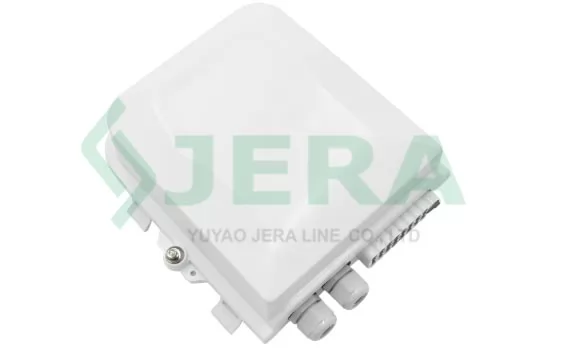
Built with durable, often flame-retardant plastics, it’s designed for both indoor and sheltered outdoor use. Its compact form factor belies its sophisticated interior, which usually includes:
-
Dedicated ports for inlet and outlet cables.
-
Integrated splice trays or modules for fusion splicing.
-
Space for mounting a 1xN PLC splitter (e.g., 1:8, 1:16).
-
Cable management features like securing clamps and bend radius limiters.
Specification of FODB-8E.3-2B, 16 core fiber optic box
|
Product code
|
FODB-8E.3-2B
|
|
Feeding cable dimensions, mm:
|
1 of ∅16
|
|
Drop cable dimensions, mm:
|
16 of ∅3, 1 of ∅10
|
|
Max splicing capacity:
|
8 (16*)
|
|
Adapters, SC type:
|
16+2 (no ears type)
|
|
PLC splitters , blockless 60x7x4 mm
|
1 of 1:16
|
|
IP protection
|
54
|
|
Overall dimensions, mm
|
210×195×86
|
Key Advantage of the FODB-8E.3-2B: The 16-Core Capacity
The standout feature of the FODB-8E.3-2B is its optimization for 16 fibers. This is not an arbitrary number; it represents a strategic sweet spot in fiber deployment. The core advantage lies in balance and future-proofing.
A 16-core box perfectly aligns with common splitting ratios in PON networks (like GPON or EPON). A standard setup might use a 1:8 or 1:16 splitter. With a 16-fiber capacity, the box can neatly accommodate:
-
1 Incoming Feeder Fiber (from the central office).
-
1x16 PLC Splitter mounted inside.
-
16 Outgoing Drop Fibers, one for each connected household or office.
This configuration utilizes the box's capacity to its fullest in a clean, logical, and scalable manner. It offers significantly higher density and connection potential than lower-count boxes (like 4 or 8-core) without the immediate cost and complexity jump to very high-count (32, 64-core) cabinets, which might be overkill for a single building or small cluster.
Why Choose a 16-Core Fiber Box?
Choosing a 16-core box like the FODB-8E.3-2B is a decision driven by practicality and foresight:
-
Optimal Density for MDUs & Clustered Homes: It is ideal for servicing an entire floor of an apartment building, a small residential block, or a row of offices from a single, centralized point. It maximizes connections per installation site.
-
Future-Proofing & Scalability: Installing a 16-core box from the start, even if initially only 8 cores are used, provides immediate room for growth. As new tenants move in or services expand, the spare ports are ready, eliminating the need for a costly secondary box or complete overhaul.
-
Cost Efficiency: It strikes an excellent balance between per-port cost and capability. Deploying one 16-core box is often more economical in material and labor than installing multiple smaller boxes to achieve the same connection count.
-
Simplified Network Management: Consolidating connections into a single, well-labeled 16-core box dramatically simplifies troubleshooting, maintenance, and record-keeping (via accurate fiber management documentation). Technicians have one primary point to work on.
-
Supports Evolving Technologies: As networks evolve towards higher-split ratios (like 1:32) or eventually XGS-PON, having a box with ample fiber capacity ensures the physical infrastructure can support these upgrades—often, only the splitter inside needs changing.
In Conclusion
In the journey of light from the central office to the end-user, the fiber box is a pivotal waystation. The FODB-8E.3-2B, with its focused 16-core design, exemplifies the intelligent planning required for modern optical networks. It delivers the perfect synergy of high density, scalability, and protection in a manageable form factor.
Choosing a 16-core fiber box is more than just selecting a component; it's an investment in network resilience, operational efficiency, and the ability to seamlessly meet future demand. For contractors and network planners looking to build robust, adaptable, and cost-effective FTTH infrastructures, the FODB-8E.3-2B and its 16-core peers represent a strategic choice that pays dividends in performance and peace of mind for years to come.





.png)