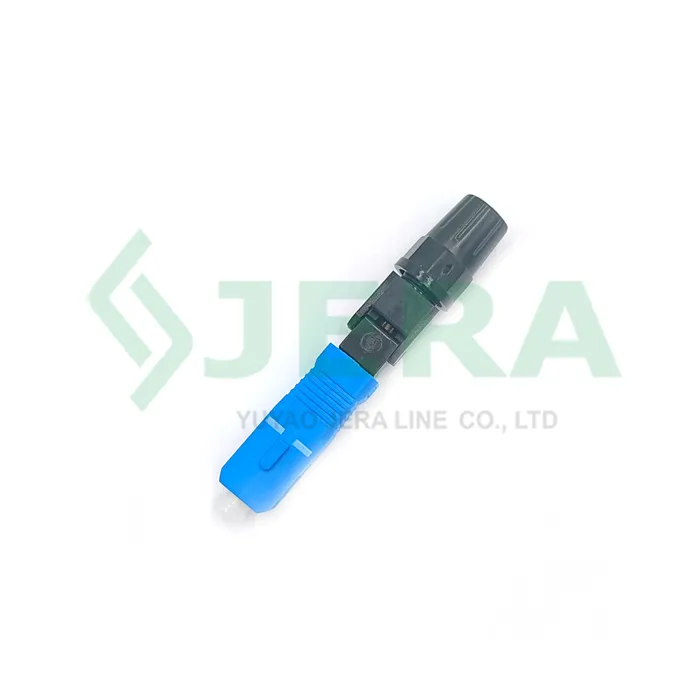
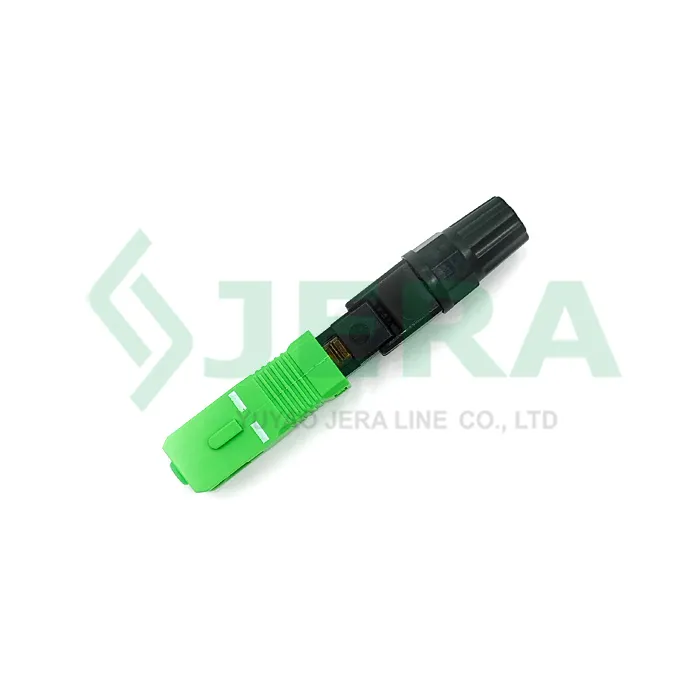
A Field Assembly Connector (FAOC), commonly referred to as a fast connector, represents a significant advancement in fiber optic network deployment technology. As an essential passive device in modern FTTH (Fiber to the Home) and ODN (Optical Distribution Network) installations, FAOCs have transformed how telecom operators, ISPs, municipalities, and enterprises approach fiber network deployment and maintenance.
Unlike traditional pre-assembled patch cords that require factory manufacturing and inventory management, FAOCs enable installers to terminate fibers directly in the field. This capability provides a quick, reliable, and cost-efficient solution for network cabling and maintenance, eliminating the need for specialized fusion splicing equipment and highly trained technicians.
The versatility and efficiency of FAOCs have made them the preferred choice for organizations looking to deploy or expand fiber networks efficiently. Whether it's a large-scale FTTH rollout covering thousands of homes or a small enterprise network installation, FAOCs offer the flexibility and performance needed to meet diverse deployment requirements.
Comprehensive Type Selection for Every Application
Jera Fiber's FAOC product line has been carefully developed to cover the full spectrum of connector types and cable compatibility options required by modern fiber optic networks. This extensive selection ensures that installers can find the perfect connector for virtually any deployment scenario.
Connector Interfaces: SC, LC, FC
Our FAOCs come in three standard interface types. SC (Standard Connector) offers push-pull engagement with square shape, ideal for general FTTH applications. LC (Lucent Connector) provides compact form factor with duplex capability, perfect for high-density installations. FC (Fiber Connector) features screw-type coupling for vibration-resistant connections in demanding environments.
Cable Compatibility: 250μm to 3.0mm
FAOCs support an impressive range of cable specifications. From 250μm tight-buffered fiber to 900μm distribution cable, and 2.0mm to 3.0mm jacketed cables, our connectors accommodate virtually any drop cable configuration used in residential and commercial installations.
Fiber Types: Singlemode & Multimode
Both singlemode and multimode fiber options are available. Singlemode FAOCs support long-distance transmission up to 20km+ without regeneration, ideal for ODN deployments. Multimode variants support shorter-reach applications like data center interconnects and enterprise LANs with OM3/OM4 compatibility.
Polish Types: UPC and APC Ferrules
UPC (Ultra Physical Contact) connectors provide low insertion loss and return loss for general ODN applications. APC (Angled Physical Contact) connectors feature an 8-degree angle that minimizes back reflection, critical for high-power applications and CATV networks.
Application Selection Guide
FTTH Last Mile: SC/UPC or SC/APC for residential drop cables
Enterprise LAN: LC/UPC for high-density rack installations
CCTV/Video: SC/APC for reduced back-reflection in video transmission
Industrial/Outdoor: FC/APC for vibration resistance and environmental protection
This wide compatibility ensures FAOCs can be flexibly applied in diverse network projects, from residential FTTH drops requiring simple, cost-effective solutions to enterprise LAN installations demanding high-density, high-performance connectivity.
Key Benefits
The Strategic Advantages of FAOC Technology
Understanding why field assembly connectors have become the industry standard for modern fiber deployment
Using FAOCs delivers transformative benefits compared to traditional fiber termination methods that rely on fusion splicing or pre-assembled patch cords. These advantages translate directly into reduced project costs, faster deployment timelines, and improved network reliability.
Elimination of Pre-Assembled Patch Cords
Factory-made patch cords require precise length forecasting, inventory management, and logistics coordination. FAOCs eliminate these complexities entirely—installers create exactly the cable length needed on-site, reducing waste and ensuring perfect cable management in every installation.
Fast, Tool-Assisted Installation
Traditional fusion splicing requires expensive equipment ($5,000-15,000+), trained technicians, and significant setup time. FAOCs use simple hand tools, enabling rapid terminations without specialized equipment. A complete termination in 3-5 minutes versus 10-15 minutes for fusion splicing dramatically improves deployment efficiency.
Customizable Cable Length
Every FTTH installation presents unique routing challenges. FAOCs allow installers to measure, cut, and terminate cables to exact lengths required, eliminating unsightly excess cable loops and improving aesthetic outcomes in residential and commercial environments.
Multiple Variant Availability
With SC, LC, FC interfaces and UPC, APC polish types available, FAOCs meet every network requirement. This flexibility enables contractors to stock a single product line and address diverse project needs without maintaining separate inventories of pre-terminated assemblies.
No Field Polishing Required
The most critical advantage—FAOCs feature factory-polished fiber stubs that guarantee consistent end-face geometry and optical performance. Eliminates the variability and quality issues associated with field polishing, ensuring every termination meets exacting performance standards.
Technical Foundation of FAOC Advantages
These transformative benefits are made possible by three core technologies integrated into every Jera Fiber FAOC:
Mechanical Splice Technology
Precision V-groove alignment and proprietary fiber clamping mechanism ensure consistent optical coupling with ≤0.35dB insertion loss. The mechanical splice design eliminates the need for fusion equipment while providing stable, reliable connections that meet or exceed industry standards.
Factory Pre-Cleaved Fiber Stub
Each FAOC contains a precision-cleaved fiber stub manufactured under controlled factory conditions. This ensures optimal cleave angles (typically within 0.5° of target) and clean end faces, guaranteeing low insertion loss performance without requiring operator skill or field equipment.
Proprietary Index-Matching Gel
Our engineers developed a specialized index-matching gel that fills microscopic air gaps at the fiber interface. This dramatically reduces insertion loss and virtually eliminates Fresnel reflections, delivering performance comparable to fusion splicing with simpler installation requirements.
In summary, FAOCs save time, reduce costs, and increase reliability in fiber optic installations. These advantages have made them the standard choice for FTTH deployments worldwide, enabling faster network rollout and easier maintenance throughout the optical distribution network lifecycle.
Installation Time per TerminationFAOC: 3-5 min | Fusion: 10-15 min
Equipment RequiredFAOC: Hand tools only | Fusion: $5K-15K splicer
Operator Skill RequiredFAOC: Basic training | Fusion: Extensive certification
Power RequirementFAOC: None | Fusion: Battery or AC power
Environmental SensitivityFAOC: Low | Fusion: High (wind, dust, temperature)
Per-Termination CostFAOC: Lower (no equipment amortization)
Use Cases
Diverse Applications of Field Assembly Connectors
How FAOCs are transforming fiber deployment across multiple industries
Field assembly connectors have proven their versatility across a wide range of network deployment scenarios. As global demand for high-speed broadband continues to grow, FAOCs play an increasingly critical role in ensuring fast deployment, easy maintenance, and cost-efficient upgrades across all types of fiber optic infrastructure.
FTTH / FTTR / FTTA ODN Networks
The primary application for FAOCs is in fiber-to-the-home, fiber-to-the-room, and fiber-to-the-antenna deployments. In FTTH networks, FAOCs enable rapid termination of drop cables at optical network terminals (ONTs) inside customer premises. For FTTR (whole-home fiber networking), FAOCs allow flexible cable routing between rooms without pre-terminated length limitations. FTTA applications in wireless tower deployments benefit from FAOC's tool-free installation capabilities in challenging outdoor environments.
Video Surveillance (CCTV)
Modern IP-based video surveillance systems increasingly rely on fiber optic connectivity for high-bandwidth, interference-free video transmission. FAOCs enable rapid deployment of fiber links to surveillance cameras, particularly in retrofit applications where running new cables through existing infrastructure is challenging. The no-polish, no-epoxy design means terminations can be completed quickly even in ceiling spaces, equipment rooms, or outdoor pole locations.
LAN and Enterprise Networks
Enterprise network upgrades from copper to fiber benefit significantly from FAOC technology. Building infrastructure projects often encounter routing challenges that make pre-terminated cable lengths impractical. FAOCs allow contractors to terminate cables on-site to exact lengths required, improving cable management in server rooms and telecommunications closets. The availability of LC-type FAOCs enables high-density connections in enterprise environments.
Data Center Connections
Data center operators face constant demands for reconfiguration and expansion. FAOCs provide the flexibility to quickly add or modify fiber connections as server and storage requirements evolve. While data center trunk cabling typically uses pre-terminated assemblies, FAOCs excel in horizontal connections and rapid reconfiguration scenarios. Their factory-polished quality ensures the low insertion loss performance required for high-speed data transmission.
Fiber Optic Maintenance and Repair
Network maintenance teams have embraced FAOCs as essential tools for rapid service restoration. When fiber cuts or connector damage occurs, FAOCs enable quick repairs without dispatching specialized splicing crews. The compact, lightweight design means technicians can carry FAOCs as standard inventory, enabling first-visit resolution of many fiber-related service issues. This capability significantly reduces mean-time-to-repair (MTTR) and improves customer satisfaction.
Smart Building and IoT Infrastructure
As buildings become smarter with integrated IoT sensors, security systems, and automated controls, fiber backbones provide the bandwidth these systems require. FAOCs simplify the installation of fiber infrastructure in both new construction and retrofit projects, enabling building owners to deploy future-proof connectivity that can adapt to evolving technology requirements.
The versatility and performance of FAOCs have established them as essential components in the modern fiber optic toolkit. As FTTH adoption continues to grow worldwide and new applications emerge for fiber connectivity, FAOCs will remain the standard choice for reliable, efficient, and cost-effective fiber optic deployments.
Step-by-Step Guide
Mastering FAOC Installation
A complete guide to achieving professional-quality terminations in minutes
One of the most significant advantages of FAOC technology is the elimination of manual polishing during installation. Unlike traditional termination methods that require epoxy application, curing time, and careful polishing to achieve acceptable optical performance, FAOCs provide consistent, factory-quality terminations using only basic hand tools. This section provides detailed instructions for achieving optimal results with every installation.
Pre-Installation Preparation
Before beginning the termination process, ensure all necessary tools and materials are available. Required tools include a fiber optic cleaver, strippers appropriate for the cable type, and the FAOC assembly kit. Inspect the FAOC components for any damage or contamination that could affect performance. Verify the connector type matches the application requirements (SC/LC/FC, UPC/APC) and that cable compatibility is confirmed.
Eight-Step Installation Process
1
Prepare the FAOC for Assembly
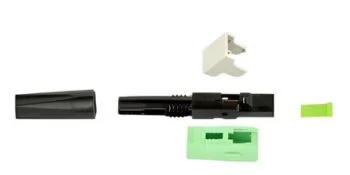
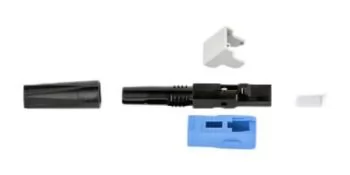
Familiarize yourself with all FAOC components: housing, connector body, boot, screw cap, and fiber holder. Organize components in the order they will be used. Verify the correct cable length measurement before cutting—always measure twice to avoid waste.
2
Insert the Screw Cap into the Drop Cable
Thread the cable through the screw cap in the correct orientation (threads facing toward the cable end). Slide the cap down the cable away from the termination point. Ensure the boot is also installed if your FAOC kit includes one—this cannot be added after termination.
3
Strip 45mm of the Fiber Coating
Using appropriate strippers, carefully remove the cable jacket to expose 45mm of buffered fiber. For 900μm buffer tubes, strip an additional 25-30mm to expose the bare fiber. Work slowly and methodically—rushing this step is the most common cause of fiber damage. Clean any residue from the stripped fiber with lint-free wipes.
4
Cleave the Fiber at 12mm
Position the fiber in the cleaver according to manufacturer instructions. The 12mm cleave length is critical—measurements that are too short or too long will result in poor optical performance or failed termination. Execute a clean, perpendicular cleave. Inspect the end face under magnification to verify a clean break without chips or hackle marks.
5
Insert the Fiber into the Connector Guide
Carefully guide the cleaved fiber into the connector's guide channel. Push slowly and steadily until you feel a slight resistance—this indicates the fiber has reached the pre-cleaved stub inside the connector. Continue gentle pressure until you feel the fiber "seat" properly. A slight bend in the exposed fiber between the cable and connector body confirms correct insertion depth.
6
Secure the Fiber Core with the Holder
Once the fiber is properly positioned, engage the fiber holder mechanism to lock it in place. This step secures the fiber against the internal stub, creating the optical connection. Apply firm, even pressure to ensure complete engagement without excessive force that could damage the fiber.
7
Tighten the Screw Cap and Close the Boot Cover
Slide the screw cap up the cable and thread it onto the connector body. Tighten securely to provide strain relief and environmental protection. If your FAOC includes a boot, slide it into position and ensure it clicks or seats properly. The boot provides additional bend radius protection where the cable exits the connector.
8
Attach the Housing to Complete the Connection
Install the connector housing over the assembly. For SC connectors, push until you hear or feel the latch engage. Verify the connector is secure by gently tugging on the cable. Your termination is now complete—proceed to visual inspection and optional OTDR testing to verify performance.
Pro Tips for Professional Results
Always clean the fiber with isopropyl alcohol before cleaving to remove any contamination
Inspect fiber end faces under 200x-400x magnification before insertion
Keep FAOCs sealed in their packaging until ready for use
Practice on sample cables before starting actual installations
Document termination locations for future reference and maintenance
This straightforward installation process enables field technicians with limited training to achieve high-quality terminations within minutes. The combination of factory-polished components and simple mechanical assembly ensures consistent, reliable performance across every installation.
FTTH Networks
FAOC: The Industry Standard for FTTH Deployment
Why leading operators choose field assembly connectors for their fiber rollout projects
As fiber-to-the-home networks expand globally, FAOCs have emerged as the connector of choice for major telecommunications operators. This section explores the specific advantages that make FAOCs indispensable for FTTH network construction and operation.
High Bandwidth Support
Modern FTTH networks must support gigabit-speed services and beyond. FAOCs provide insertion loss specifications (≤0.35dB) that easily meet the optical budget requirements for 10Gbps and 25Gbps GPON/XGS-PON deployments. The stable, low-loss performance of mechanical splice connections ensures reliable service delivery throughout the network lifespan.
Flexibility and Convenience
FTTH deployment teams operate under diverse field conditions—in homes, basements, aerial installations, and underground enclosures. FAOCs adapt to these varied environments without requiring specialized equipment or power sources. Installers can respond to unexpected routing challenges and complete terminations regardless of site conditions.
Ease of Maintenance
Network maintenance and customer service calls often require connector replacement or re-termination. FAOCs enable quick repair or extension without specialized tools or dispatching fusion-splicing technicians. This capability dramatically reduces mean-time-to-repair and improves first-visit resolution rates for service-affecting issues.
Cost-Effectiveness
The economic advantages of FAOCs compound across large-scale deployments. Eliminating fusion equipment costs, reducing specialized labor requirements, and accelerating deployment timelines all contribute to significant project cost reductions. Operators report 30-50% reduction in per-drop termination costs compared to traditional methods.
The FTTH Deployment Challenge
Mass-scale FTTH deployment presents unique operational challenges that FAOCs specifically address. Building a network serving millions of subscribers requires connecting thousands of homes per week in some markets. This scale demands solutions that are not only technically sound but operationally practical.
Traditional fusion splicing requires expensive, fragile equipment that must be maintained and calibrated regularly. Battery life limits daily productivity, and environmental conditions (wind, dust, temperature extremes) can prevent splicing operations entirely. In contrast, FAOCs use simple hand tools that are inexpensive, durable, and require no maintenance or calibration.
Meeting Subscriber Expectations
FTTH subscribers expect rapid service activation—often within days of order submission. FAOCs enable installation teams to complete customer premises terminations quickly, supporting aggressive activation schedules. The clean, professional appearance of FAOC-terminated cables also contributes to positive customer impressions of service quality.
As FTTH adoption continues to grow worldwide, FAOCs have earned their position as the standard choice for reliable fiber connectivity. The combination of technical performance, operational convenience, and economic advantage makes them essential components of any modern FTTH deployment strategy.
Product Range
Jera Fiber: Your Trusted FAOC Partner
Professional manufacturer delivering quality connectors worldwide
At Jera Line, we have established ourselves as a professional fiber optic drop cable and connectivity solutions manufacturer based in China, near Ningbo Port. Our strategic location enables fast and cost-efficient global delivery to customers worldwide, supporting FTTH projects across continents with reliable supply chains and responsive service.
Our comprehensive FAOC product range includes solutions for every application requirement:
SC/UPC fast connector — The standard choice for general FTTH and enterprise network applications
SC/APC fast connector — Optimized for video transmission and low-reflection requirements
Type 10 SC/UPC fast connector — Enhanced design for high-density environments and demanding installations
Type 10 SC/APC fast connector — Combines Type 10 advantages with APC polish for specialized applications
Why Global Customers Choose Jera Fiber
Our commitment to quality, value, and service has made us a trusted partner for telecom operators, system integrators, and network installers worldwide.
Proven Quality
All FAOC products are manufactured under ISO-certified quality management processes. Every connector undergoes rigorous optical and mechanical testing to ensure consistent performance that meets or exceeds international standards (TIA/EIA, IEC, Telcordia).
Competitive Pricing
Our efficient manufacturing operations and strategic sourcing enable us to offer FAOCs at highly competitive price points. This cost-effectiveness makes FAOCs ideal for mass FTTH deployment projects where per-unit costs significantly impact project economics.
OEM Production
We offer customized solutions including branded packaging, custom specifications, and private-label manufacturing for customers with specific requirements. Our engineering team works closely with customers to develop products that meet unique application needs.
Responsive Service
Our dedicated technical support team provides assistance with product selection, installation guidance, and troubleshooting. With fast lead times and reliable global logistics, we ensure customers receive products when and where they need them.
By integrating Jera Fiber FAOCs into your FTTH ODN deployment, you can achieve faster rollout, better network reliability, and reduced project costs. Our products have been deployed in millions of connections worldwide, proving their quality and reliability in demanding real-world applications.
Ready to Transform Your Fiber Deployment?
Contact our team today to request product samples, competitive quotations, or technical consultation. Our fiber optic specialists are ready to support your project requirements.




.png)




_1757299763_WNo_1662d538.webp)
_1757312145_WNo_1662d932.webp)